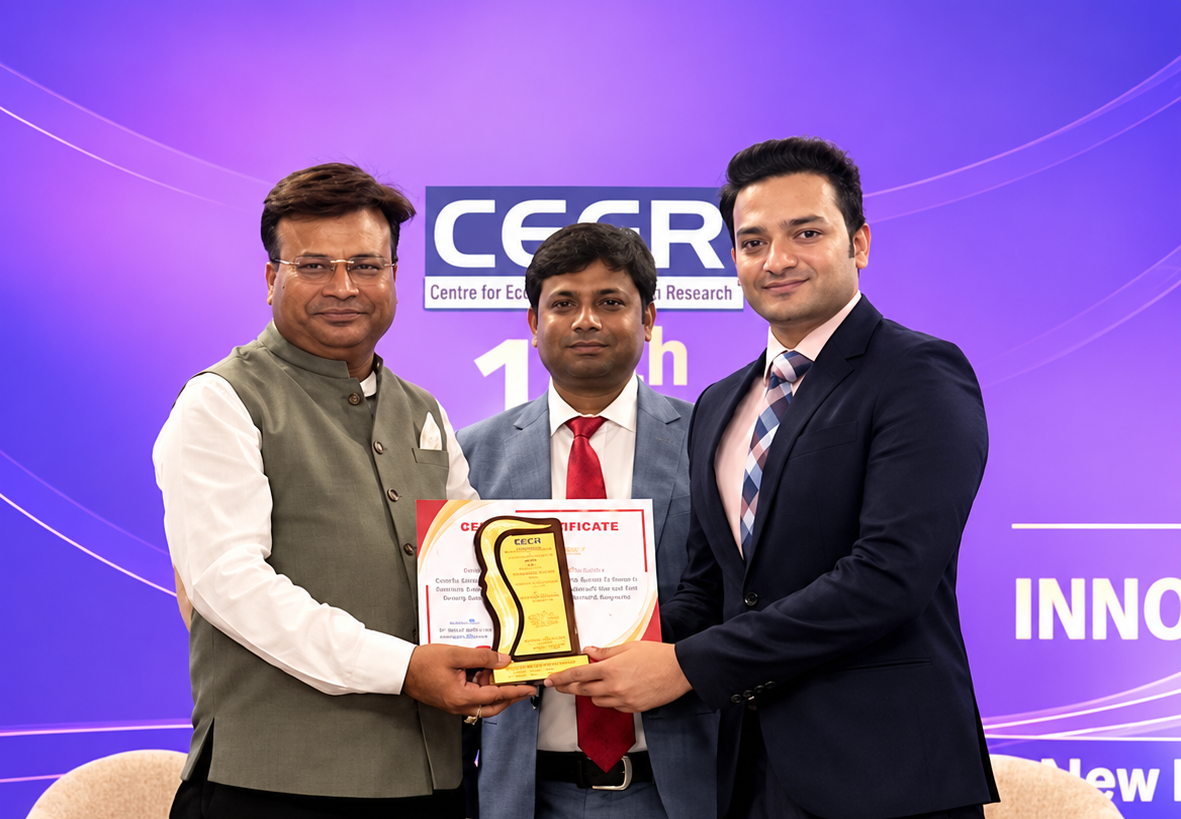

By: Prof. (Dr.) Pavitar Parkash Singh, Senior Dean & Coordinator of Faculty (COF), School of Liberal & Creative Arts, Lovely Professional University
Universities have always operated on the same principle: students for knowledge. However, according to the Economic Survey 2025-26, 75% of higher education institutes in India are not ready to face the challenges posed by industries, while only 25% of them use live projects from industries and 26% incorporate internship programmes in their curriculum. For coming to lectures, the students receive knowledge, examination and, finally, a degree. However, that knowledge is only a small part of what they are supposed to know.
As soon as they step into their first job, the students understand that theory that they have studied at university was just a starting point to solve practical problems in the future. It can be a case of engineers that are faced with financial limitations while designing the system, managers who develop a business model or even communicators who work with client briefs. The point is, no matter which field they choose, these students are going to be exposed to demands that go far beyond what they’ve been taught in a classroom.
The challenges become visible when theoretical knowledge needs to be applied with practical limitations in mind. The India Skills Report 2026 puts overall employability at 56.35%, highlighting the gap between academic qualification and workplace readiness.
Having an academic understanding of the theory behind marketing, for instance, doesn’t prepare someone for a career in marketing as well as actually having to construct a campaign. This is why experience, in addition to education, is so valuable. And that is precisely why experiential learning is rapidly becoming an indispensable component of higher education.
Universities must encourage students to put classroom learning to practical use while they are still on campus; an internship completed solely to satisfy a graduation requirement, for example, is not experiential learning. Nor is completing a textbook research paper equivalent to conducting original research. Students need to be exposed to challenges and responsibilities that require them to make decisions, solve problems, communicate, collaborate, and reflect on their own work for the learning process to be truly meaningful.
Industry projects, research, fieldwork, live entrepreneurial activity, competitions and simulations, and community engagement are all ways students can gain valuable hands-on experience.
The UGC’s undergraduate internship framework also reflects this shift, providing for internships carrying 2–4 academic credits, equivalent to 60–120 hours after the fourth semester.
The philosophy underpinning Lovely Professional University’s Edu Revolution initiative recognises this need and incorporates experiential learning, industry exposure, live projects, internships, innovation, entrepreneurship, and other aspects into the university learning experience.
LPU’s Earn Your Fee Back philosophy encourages students to work on live projects, internships, consultancy, and entrepreneurship to hone their skills. In addition to providing them with a meaningful learning experience, these opportunities allow them to make a positive impact.
Live projects are valuable because they provide the context for students to gain professional judgment in addition to academic knowledge. Working on a live project means making decisions, communicating those decisions to others, and reflecting on and adjusting them when the results aren’t optimal.
A similar learning experience can be gained through consultancy or even through an entry-level role, if students are given the right opportunity. If you’re being paid to write a report, design a website, or conduct research, you’re being held accountable to a standard that goes far beyond your academic requirements. You have a client who wants certain information presented in a specific way, and it’s your responsibility to provide it. That’s a valuable learning experience for students, as the professional world rarely rewards them for merely knowing things. It holds them to a much higher standard.
The same can be said about failure. Real-world projects allow students to experience when expected results are not received well, and to learn how to respond, improve and adapt.
The same goes for the challenges and opportunities you face when you’re first starting in your career. The ability to learn and adapt, especially in response to adverse circumstances, is a skill that most students don’t have when they enter the workplace, but that companies value once they acquire it. The World Economic Forum’s Future of Jobs Report 2025 estimates that 39% of workers’ core skills will change by 2030.
Experiential learning also serves to bridge the gap between higher education and the workplace.
When universities engage directly with the industry, they get a better understanding of workplace needs, and in doing so, also fulfil those needs more effectively. Industry experts can provide front-line insights from their respective fields, whether by collaborating on projects or mentoring students. As of January 2026, more than 18,000 professionals had registered as Professors of Practice across 536 institutions through the UGC platform.
Companies can provide students with employment opportunities, and universities can support them in developing a professional outlook that reflects workplace expectations.
Students, for their part, benefit immensely from this collaborative approach. Their academic performance on paper tells only a part of their story, and the rest can be found in their work, their experiences, and their ability to reflect on both. Students will be given an opportunity to exhibit their capabilities in a practical setting and even gain confidence in presenting the same to others through experiential learning. They can acquire this professional skill way before they can apply it in their respective professions.
Higher education in the future does not lie in the choice between theory and practice; students need both. Academic knowledge gives them a solid foundation on which to base their experience, while experiential learning reinforces that foundational knowledge.
Acquiring an education means knowing how to think and knowing how to apply that thinking is what makes someone truly educated. The journey from one to the other shouldn’t start from outside the classroom but from within it. It is up to universities to create the conditions for students to turn theoretical knowledge and practical experience into meaningful learning outcomes. By allowing students to engage with the world around them, turn their knowledge into something valuable, learn and, more importantly, fail, universities can give students what they can’t get anywhere else: the ability to make their own education useful to them.