By: Dr. Sandeep Bhardwaj, Director, Vivekanand Business School, Vivekanand Education Society
Education is no longer confined by geography; it is global in both opportunity and expectation. There was a time when a degree led to a lifelong career in the same place, but today, that path has evolved. The focus is shifting beyond degrees to skills, exposure, and adaptability. To stay relevant, students must step out of their comfort zones and embrace a more international outlook- one that prepares them to thrive in a connected, global world.
A student’s education goes beyond the boundaries of their nation in today’s world. Most students today are preparing for careers that they know will transcend borders. According to the World Economic Forum, the workforce of tomorrow requires the competence to be global as well as technical. If the world is soon to be an interconnected village thanks to technology, learners in the present landscape must face exposure to international systems so that they can better align themselves with the reality of global evolution.
A Global Workplace
Companies today have superseded the limitations of geography, with teams distributed across continents. Teams are being deployed remotely by global clients with wildly different time zones. As such, employees are expected to effortlessly collaborate with people they don’t share similar linguistic or cultural backgrounds with. Exposure to people from diverse locations early-on helps students develop confidence in such situations. Cultural intelligence, the ability to understand and adapt to different cultural contexts, is priceless in this context. Interacting with global peers reduces cultural bias and promotes inclusive thinking among students. Culturally intelligent individuals have the tools to perform better in diverse teams. Hybrid work and the gig economy is also a reality. The shift has started from locally-centralized jobs to internationally-recognized careers.
Being a Better Communicator
When we say that international exposure leads to an improvement in communication skills, we mean more than that students get to learn new languages. It is possible to be fluent but still ineffective in a language if you do not have communication skills. Understanding tone, context, and non-verbal communication across cultures is how you build your skillset in communications. Global exposure significantly improves communication competence, making students become better listeners and more nuanced communicators. There is a core difference between being good at a language, and being good at language, one that has to do with fluency and the other has to do with effectiveness.
Broadening Academic Horizons
Every country has a different approach to teaching methodologies and learning. Diverse exposure to varied academic systems introduces students to alternative ways of thinking. A system in one country might be more focused on research, while another might be more experiential. Diversity in learning systems strengthens critical thinking and analytical abilities. UNESCO agrees that global education systems, which integrate various avenues of disciplines, lead to the development of students who are prepared to solve real-world complex global challenges. Exchange programs, joint degrees and collaborations between universities lead to a culture of creating independent thinkers.
Checking the Box on Employability
Candidates with global experience see their opportunities expanding. They are viewed as adaptable, open-minded, and globally aware. Early exposure to international opportunities also opens paths to interactions with international peers and faculty which in turn creates long-term connections. These networks can lead to collaborations, job opportunities, and knowledge exchange which significantly enhance career mobility.
Promoting Soft Skills
Exposure to global issues provides a broader understanding of challenges as students learn to approach problems from multiple perspectives. Diverse exposure improves innovative thinking. Living and studying abroad also makes for a different environment that requires students to manage daily life independently. They learn time management, financial responsibility, and decision-making as they learn how to stand on their own two feet. Students exposed to international settings early on become more comfortable with change. They become more receptive to exploring new opportunities, which reduces anxiety around uncertainty.
Ethical Growth Amidst Technology
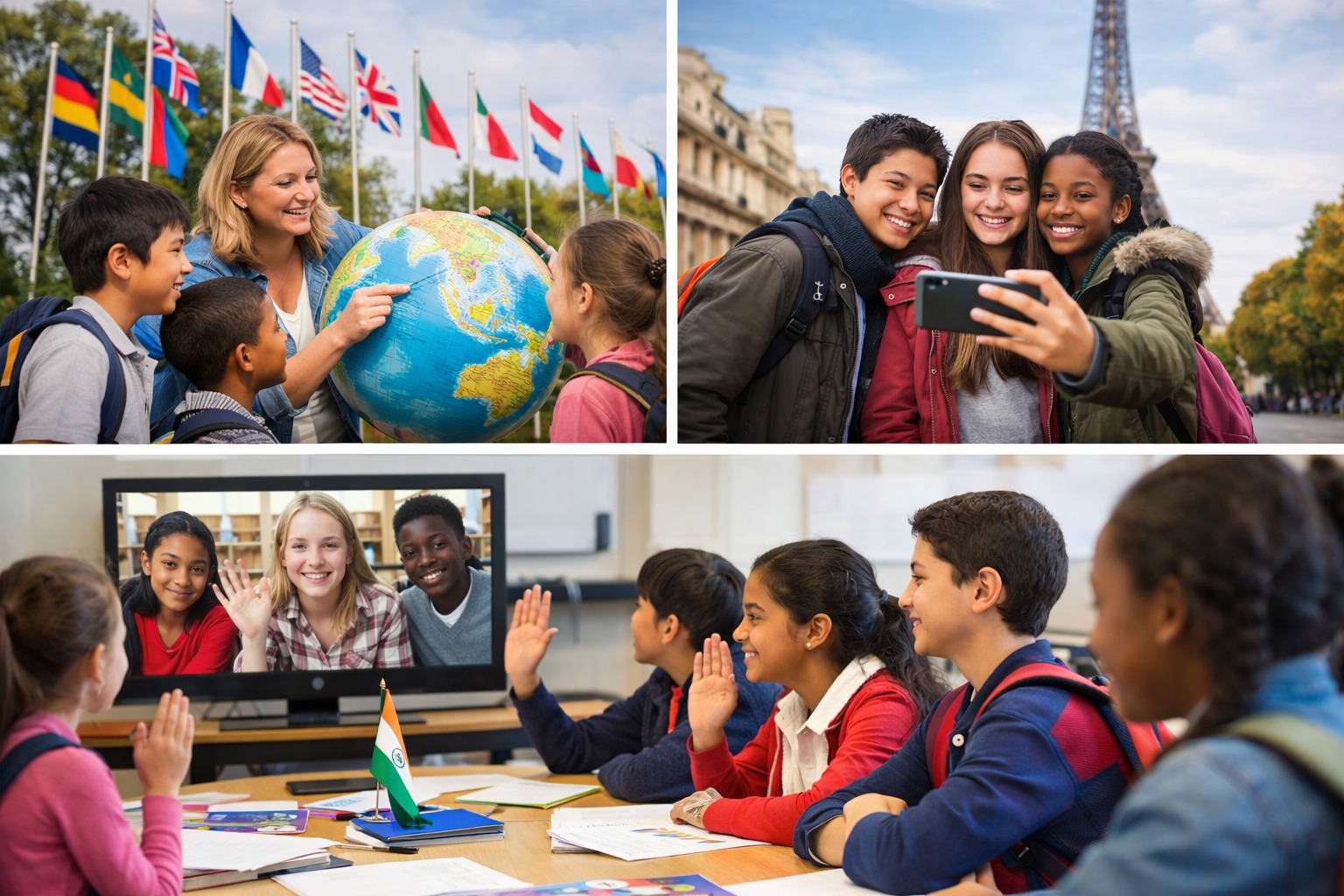
Technology has made the world smaller and now it is easier to get exposure to different socio-economic realities which foster responsibility. This shapes ethical leadership. It is also now possible to take the benefit of global exposure without leaving home. Virtual exchange programs and global classrooms are increasing, allowing students to access international experiences without travel. Online classrooms with global peers lead to digital exposure that boosts self-awareness, as learners from different corners of the world start to understand the different set of cards they’ve been dealt.
Global Citizenship and Responsibility
There exists a world far beyond the boundaries of one’s own nation, one that is increasingly interconnected in ways that make geographic distance almost irrelevant. While this may appear to be common knowledge, the reality is that developments in one part of the world inevitably create ripple effects elsewhere. Challenges such as global inequality, climate change, and resource scarcity are no longer abstract concepts confined to academic discussions or Model United Nations simulations. With international exposure, students engage with these issues in real-world contexts, gaining a deeper understanding of their complexity and urgency. This firsthand experience fosters a sense of responsibility and agency, encouraging students to contribute meaningfully to global solutions. In turn, the perspectives and changes they carry forward abroad often translate into impactful contributions within their own communities and countries.
The Indian Angle
India is one of the largest suppliers of global talent across tech, healthcare, consulting, and academia. Even while based in India, Indian professionals are adding to the global workforce by working in cross-border remote roles. Employers now expect Indian graduates to be globally competent, not just technically skilled. This shifts education expectations within India itself. Indian students already know what diversity looks like. Students already grow up navigating diversity domestically which gives them a natural base for global adaptability. This can be formalized by international exposure. India is also deeply integrated into global supply chains and service industries with startups, MNCs, and even domestic firms operating globally. Students entering these ecosystems need cross-cultural competence from day one. This is now the need of the hour.
The Bottomline
The demands of the modern workforce require global awareness. International exposure has shifted from being an added advantage to a fundamental requirement in modern education. It equips students not only with academic knowledge but with the ability to navigate complexity, diversity, and rapid change. As industries become increasingly interconnected, the value of global competence continues to rise. Education systems that integrate international perspectives are better aligned with real-world demands. Ultimately, students with global exposure are not just better professionals, but more informed, adaptable, and responsible individuals prepared for an interconnected future.