
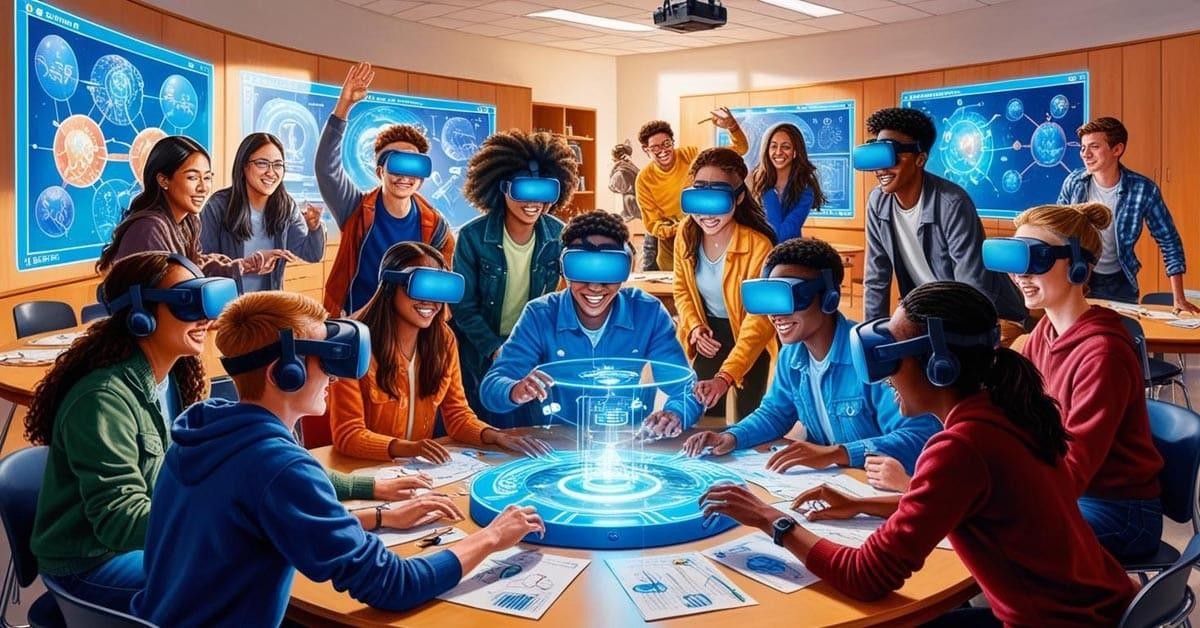
Education is undergoing a fundamental shift. As industries evolve faster than traditional curricula, the gap between classroom learning and real-world application is becoming increasingly evident. To bridge this divide, institutions are turning to immersive and interactive learning tools that move beyond passive instruction to active, experience-driven engagement.
Immersive and interactive tools in modern learning are technologies and methods – including simulations, augmented reality (AR), case-based learning platforms, and digitally layered content that shift education from passive information transfer to active, experience-driven engagement. They improve conceptual clarity, knowledge retention, critical thinking, and practical readiness for real-world professional environments.
By enabling students to engage with real-world scenarios in controlled environments, these tools make application a core part of learning. From business simulations and medical training modules to engineering design platforms, learners are increasingly developing skills through practice rather than theory alone.
Education is undergoing a fundamental shift. As industries evolve faster than traditional curricula, the gap between classroom learning and real-world application is becoming increasingly evident. To bridge this divide, institutions are turning to immersive and interactive learning tools that move beyond passive instruction to active, experience-driven engagement.
Immersive and interactive tools in modern learning are technologies and methods – including simulations, augmented reality (AR), case-based learning platforms, and digitally layered content that shift education from passive information transfer to active, experience-driven engagement. They improve conceptual clarity, knowledge retention, critical thinking, and practical readiness for real-world professional environments.
By enabling students to engage with real-world scenarios in controlled environments, these tools make application a core part of learning. From business simulations and medical training modules to engineering design platforms, learners are increasingly developing skills through practice rather than theory alone.
“Immersive and interactive tools are steadily transforming the way learning is experienced, moving beyond passive consumption to active engagement. By integrating simulations, case-based learning, and real-time digital interfaces, learners are better able to connect theoretical concepts with practical application. This not only enhances comprehension but also builds critical thinking and problem-solving skills that are essential in today’s dynamic environment.”— Prof. Pratima Daipuria, Dean, PGDM Program, JIMS Rohini
At the school level, immersive methods are strengthening conceptual clarity by allowing students to interact with and visualise concepts rather than simply memorising them. This leads to better understanding, retention, and confidence in applying knowledge.
“When students can experience and interact with concepts through visual tools, simulations, and hands-on methods, learning becomes more intuitive and relatable. This shift from passive to active learning not only strengthens understanding but also improves retention and confidence. Integrating such approaches into everyday learning encourages curiosity and participation.”— Ms. Srividya Sridhar, Principal, Lotus Petal Senior Secondary School
The shift is also transforming educational content. Traditional textbooks are evolving into interactive formats with QR codes, augmented layers, and multimedia integrations that extend learning beyond the page.
“From QR codes and augmented content to digitally supported formats, content today is no longer static but layered and dynamic. These innovations allow learners to interact with material beyond the page, improving both comprehension and retention. By blending strong editorial design with digital integrations, publishing can create more engaging and immersive learning experiences.”— Mr. Atishay Jain, Director, Koncept Global Books
As employers continue to prioritise skills like adaptability, problem-solving, and decision-making, immersive learning is emerging as a direct pathway to industry readiness. By simulating real-world challenges, it equips learners not just with knowledge, but with the ability to apply it effectively.
As this shift accelerates, the focus of education is becoming clear: preparing learners not just to know, but to do.