
Melbourne, Australia: Two Monash University researchers have been awarded prestigious Australia-India Strategic Research Fund (AISRF) Early and Mid-Career Researcher (EMCR) Fellowships, supporting new and expanded joint research initiatives with the Indian Institute of Technology (IIT) Bombay.
In parallel, a Monash-led collaborative project with the National Institute for Plant Genome Research (NIPGR) in Delhi has secured AISRF funding to help safeguard one of India’s most important crops against heat stress.
Rice is a staple food for billions of people around the world, including hundreds of millions of Indian households. Rising temperatures and increasingly frequent heatwaves threaten yields and farmer livelihoods, and drive food insecurity.
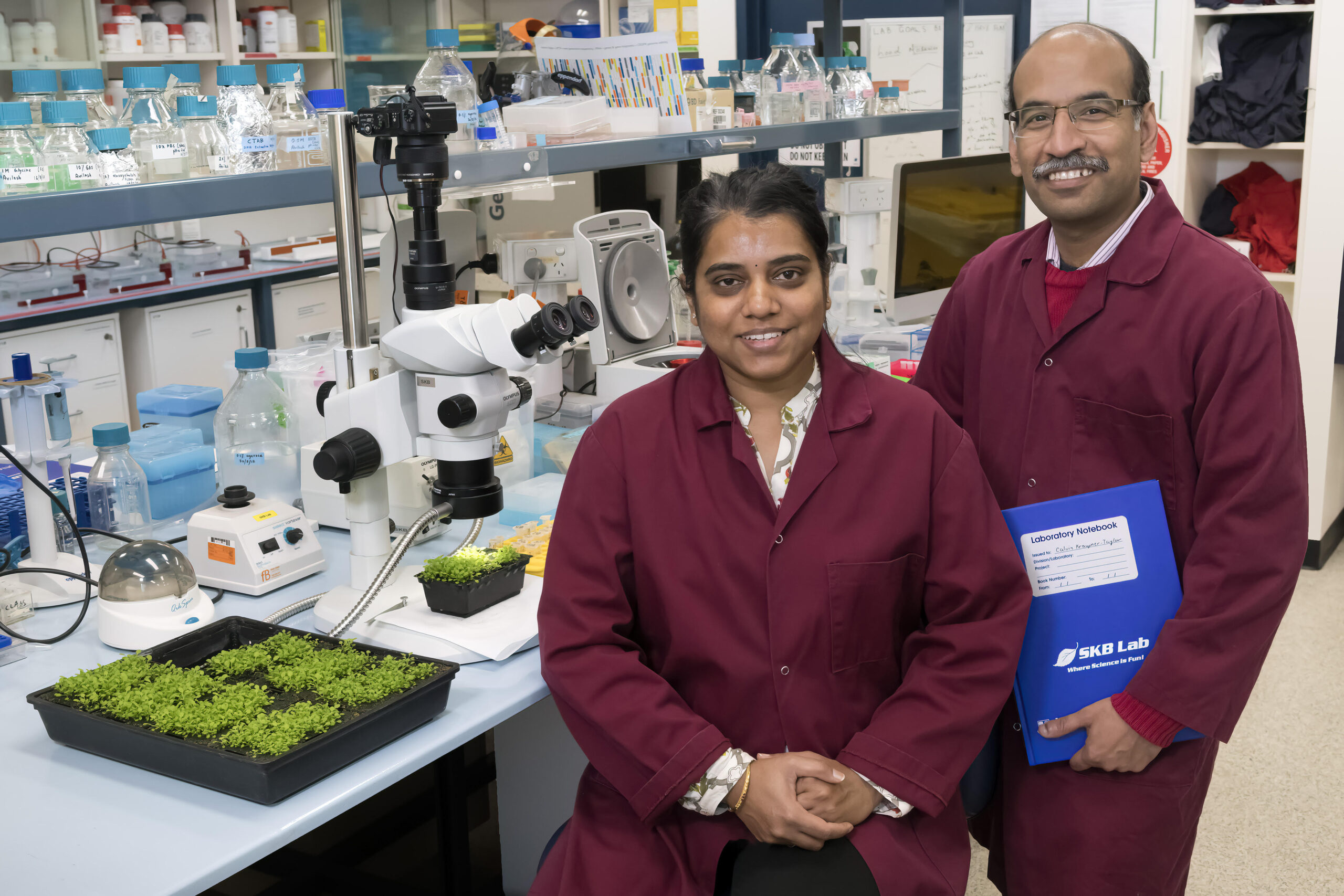
Led by Professor Sureshkumar Balasubramanian and Dr Sridevi Sureshkumar from Monash’s School of Biological Sciences, the team is partnering with the NIPGR on an AISRF-funded project to engineer heat tolerance in rice using AI and genome editing. The project – one of only five awarded nationally – has received ₹6,11,54,342 INR in funding, while the NIGPR has also received funding from the Indian Government’s Department of Biotechnology.
The team from Monash’s School of Biological Sciences is working closely with Professor David Powell from the Monash e-Research Centre and Professor Sefi Rosenbluh from the Monash Biomedicine Discovery Institute, alongside colleagues at NIPGR, to translate cutting-edge plant science into practical outcomes for farmers.
“As global temperatures rise, crops like rice are increasingly exposed to heat stress that can dramatically reduce yields,” Professor Balasubramanian said.
“By combining artificial intelligence with precision genome editing, we can accelerate the development of rice varieties that are better able to withstand higher temperatures, helping to safeguard food supplies for communities in India, Australia and beyond.”
The project draws on complementary strengths: Monash brings expertise in AI, plant genomics and gene editing, while NIPGR contributes world-leading capabilities in plant genome research and an in-depth understanding of local varieties, growing conditions and farmer needs.
Monash’s success in the latest round of AISRF EMCR Fellowships further highlights the depth of collaboration between Australia and India.
Dr Deval Mehta in the Department of Data Science and AI and founding member of the Augmented Intelligence and Multimodal analytics (AIM) for Health Lab at Monash’s Faculty of Information Technology, has been funded to further advance his established cross-national collaboration in digital health with IIT Bombay.
From long travel distances to shortages of specialists, many underserved communities in remote regions of India and Australia face similar barriers to access quality healthcare. Dr Mehta’s research explores how cutting-edge AI and digital technologies can improve access to quality care in remote regions by providing better screening, diagnosis and ongoing management of health conditions, while easing pressure on overloaded health systems.
“My collaboration with IIT Bombay has laid a strong foundation in AI-driven healthcare technologies, and this fellowship will accelerate and expand that work,” Dr Mehta said.
“By drawing on diverse datasets, cultural insights and complementary technical expertise across our two countries, we can build health services and systems that are more inclusive, more accurate and more equitable for everyone.”
Fellow AISRF EMCR recipient Dr Rishabh More from the Faculty of Engineering is tackling one of the planet’s fastest-growing environmental threats: microplastics.
His fellowship will strengthen collaboration with IIT Bombay on data-driven modelling of how tiny plastic particles settle and build up in rivers, lakes and coastal environments. Although microplastics are now found from the Himalayas to the deep ocean, their movement, accumulation and long term effects remain poorly understood.
“Better models mean better decisions about how to prevent build up or reduce harm,” Dr More said. “I’ll be partnering with Indian colleagues with data from local waterways to produce insights that support targeted clean up, smarter regulation and, ultimately, healthier environments for people and wildlife.”
The AISRF, which marks its 20th anniversary this year, has been a cornerstone of scientific partnership between Australia and India. Monash’s latest successes reflect the university’s longstanding engagement with Indian institutions, particularly through its joint initiatives with IIT Bombay and its presence in Mumbai.
For researchers in India seeking Australian collaborators, Monash offers long standing partnerships with leading Indian institutions. These relationships support joint projects, shared expertise and impact driven research aligned with India’s priorities, from climate resilient agriculture to digital health and environmental protection.
Indian students considering a PhD can also access joint programs through the IITB-Monash Research Academy, which provides integrated supervision, international research experience and opportunities to contribute to projects with practical relevance across both countries.